
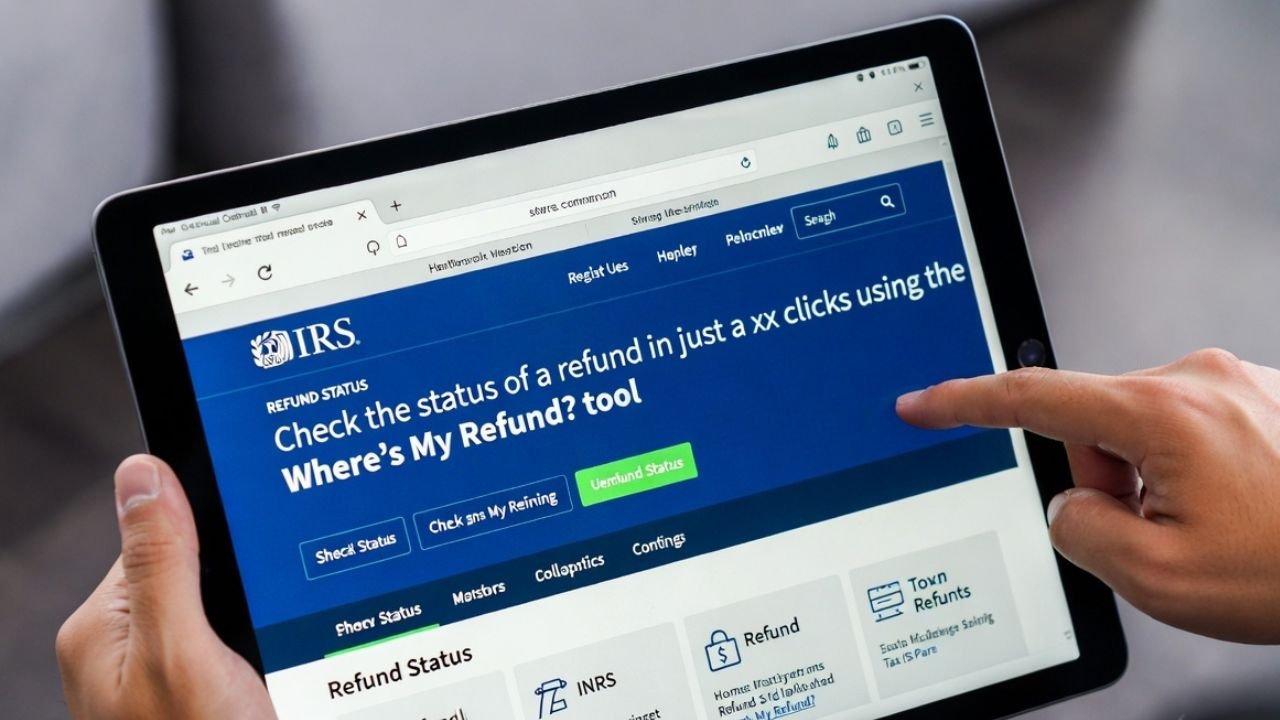
IRS: When tax season comes by every year, hundreds of thousands of people submit their tax returns in February and March. The majority of citizens are hoping that they will receive the tax refund in their bank accounts in only a few weeks. But it usually turns out that individuals check their bank accounts more than once, and they do not see anything indicating their refund. And in the event that you are in this predicament, you should not worry. The American tax collector, the Internal Revenue Service (IRS) has given us a easy way by which you can directly know the actual phase your refund in.
How to Check Your Status Using the “Where’s My Refund?” Tool

A tool called Where My Refund? is the simplest way to go with checking the status of your tax refund. This is a tool offered both on the official IRS site and the mobile application, IRS2Go. When you have e-filed your tax return (are we not calling you electronic here too), you can start checking the status of your refund immediately after 24 hours of filing. A paper return, on the other hand, might require the system up to four weeks to receive the information.
One aspect that makes the use of this tool special will be the fact that unlike other tools that give you a generic response such as Pending, this tool also gives you an approximate date when your refund will be received. This particular date is the greatest amount of information to you.
Step 1: Visit the IRS Website or App
To begin with, it is necessary to go directly to the official governmental IRS site or to the IRS2Go application. Although there are also numerous third-party tax websites, which provide a refund tracker, they use the information provided by the IRS anyway. Thus, in most cases, it is better to work with the official platform itself.
To check your status, you will need to provide three pieces of information:
- Your Social Security Number (SSN) or ITIN
- Your filing status
- The exact dollar amount of your refund
The most common error occurs with this last piece of information. If you enter an amount that is off by even a single dollar, the system will be unable to match your information.
Step 2: Understand the Three-Stage Tracker
The details are usually shown in the refund tracker in three phases. The former stage allows you to know that your return is received by the IRS. The second phase implies that your refund is in the process of review and approval. The third phase would come after you are ready to issue your refund.
Once the status becomes Approved, that is, it is being refunded through a direct deposit to your bank account or sent in a check through the mail to your address. The normal processing time in a bank is 1230 business days, but it can be expanded by a few days during weekends or federal holidays.
Step 3: Repeated Calls Will Not Expedite the Process
It is also a common tendency of people to call back the IRS instantly and complain about the delay in getting their refund but it does not help to speed this process. The data shown on the Where My Refund Tool is the same information the staff of the IRS call center have.
In case of any reason and inability to utilize the online tool, then you can call the IRS automated refund hotline at 800-829-1954. Call wait times may however be very long during tax season.
Primary Reasons for Tax Refund Delays
Technical problems or mistakes in the information that is presented can often cause delays in the refunds. Very often, people do not sign their tax returns or do some small mistakes in calculations. Moreover, when you have already received the Earned Income Tax Credit or the Additional Child Tax Credit the IRS must carry out further checks which may consume more time.
The government can in some cases use part of your refund to pay up any existing debts or liabilities. This is carried out under Treasury offset program. These offsets can include child support arrears, state or federal debts, and other money debts.
Typical Wait Times for Tax Refunds
In most cases, the IRS can make refunds on e-filed returns within a period of up to 21 days. This may be a longer period in the case of paper returns. In case of the elapsing of the 21 days and your tracker shows the received, there is a possibility that your tracker has been selected to undergo further examination.
Remember that IRS updates this tool only once a day – usually at night. Thus, you see no advantage of checking your status two or three times a day; it is enough to check it in the morning and you also save your time.
Leave a Reply